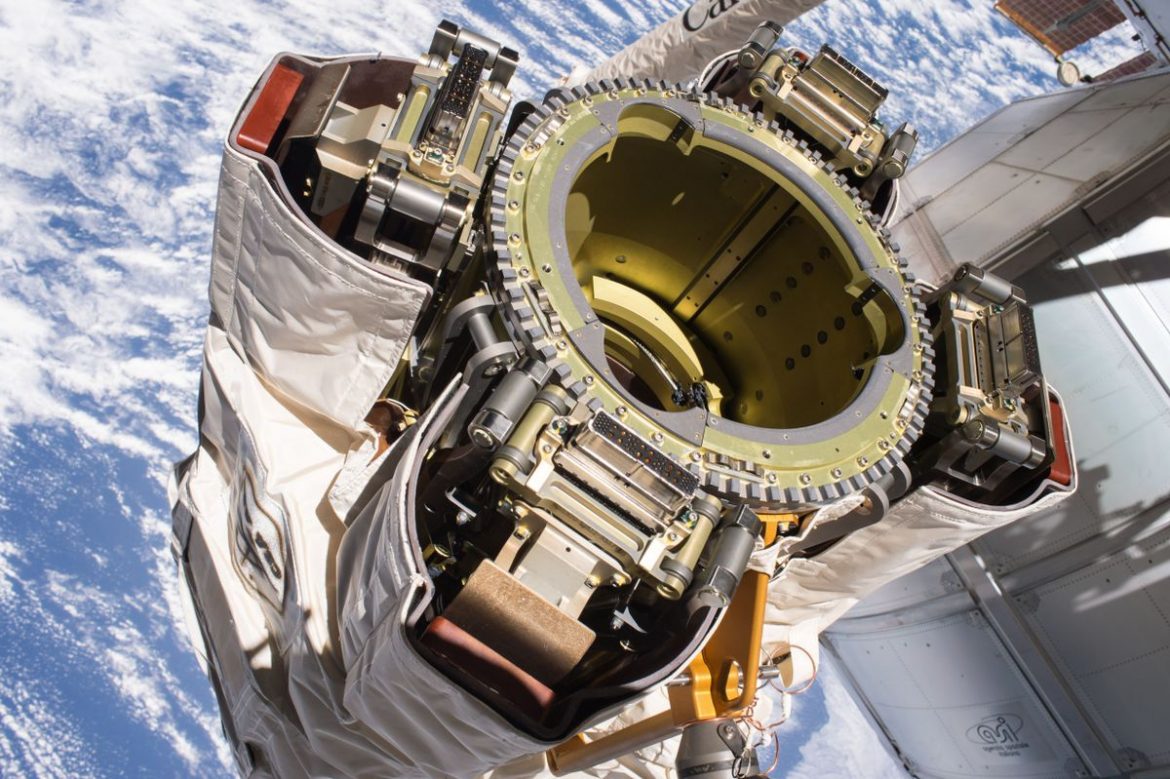
A Canadarm, also known as Shuttle Remote Manipulator System (SRMS), is a chain of robotic arms used on the space shuttle orbiters to install, maneuver, and catch payloads. It is Canada’s most celebrated milestone in the field of robotics. After the Space Shuttle Columbia disaster, paired with the Orbiter Boom Sensor System, came in handy while inspecting the shuttle’s exterior for damage to the thermal protection system.
Flight history of Canadarm
NASA invited Canada in 1969 to participate in the Space shuttle program to develop a manipulator system. A total of five Canadarms were built and delivered to NASA. They successfully operated for 30 years until its final flight in July 2011.
• 1981 to 1990
On 13th November 1981, Canadarm was deployed out of the Shuttle Columbia’s cargo bay for the very first time.
• 1991 to 2000
Canadarm was used in the deployment of Compton Gamma Ray Observatory.
Canadarm was used by Pilot Michael J. Bloomfield to support spacewalkers during three EVAS totaling 19 hours,20 minutes.
• 2001 to 2010
-In February 2001, Canadarm was used to remove a station docking port. Making room for installation of U.S Laboratory Module Destiny. Towards the end of May 2010, Canadarm 1 and 2 worked together to install Rassvet.
• 2011 to date
Mission STS-135 made history as shuttle Atlantis performed the last flight of the Space Shuttle program. It delivered Raffaello multi-purpose logistics module containing supplies and spare parts.
Canada in space
Canada becomes the third country in the world to fly to space in 1962 with the launch of Aloutte-1. Ever since, it has played an integral role in health science, satellite technology, and robotics.
Some of the satellites Canada has invested in are:
1. Earth observation satellites
These satellites are essential in monitoring and protecting our environments, managing our resources, and ensuring Canadians’ safety and security.
They include RADARSAT Constellation (CSA), RADARSAT-2(MDA) and WildFireSat(CSA).
2. Communication Satellites
As a way of connecting communities even in remote geographical areas, it assists search and rescue teams, beaming instructors to classrooms and providing ships and aircrafts with geopositioning information.
They include ANIK E1(Telesat Canada), ANIK E2(Telesat Canada) and M3MSat(CSA).
3. Science satellites and spacecraft
Canada has unique gadgets on its science satellites, some of which have expanded our understanding of the origin and evolution of celestial bodies and the universe.
The operational satellites are BRITE Constellation, CASSIOPE(MDA), and NEOSSat (CSA/DND).
4. Canadian CubeSat Project
This program provides professors in post-secondary institutions the chance to engage their students in actual space missions. Winning teams are tasked with designing and building their miniature satellites called CubeSat.